
Study a Module, Not a Whole Degree: Modular Funding Under the LLE
Until now, student finance in England has mostly meant signing up for a full degree. The Lifelong Learning Entitlement (LLE) changes that. From January 2027, you’ll be able to get funding for individual modules, which could make it much easier to upskill while working.
What can be funded?
Funding will be available for:
- Modules of approved Higher Technical Qualifications (HTQs) at levels 4 and 5
- Level 4, 5 and 6 modules from full level 6 qualifications (such as degrees) in subjects that address priority skills gaps and fit the government’s industrial strategy
Applications for modules open from late October 2026.
Which subjects are covered?
The subject groups eligible for modular funding are:
- Computing
- Engineering
- Architecture, building and planning (excluding landscape gardening)
- Physics and astronomy
- Mathematical sciences
- Nursing and midwifery
- Allied health professions
- Chemistry
- Economics
- Health and social care
The rules a module must meet
To qualify, a module has to:
- Be part of an existing designated full course, delivered by the same provider as the parent course
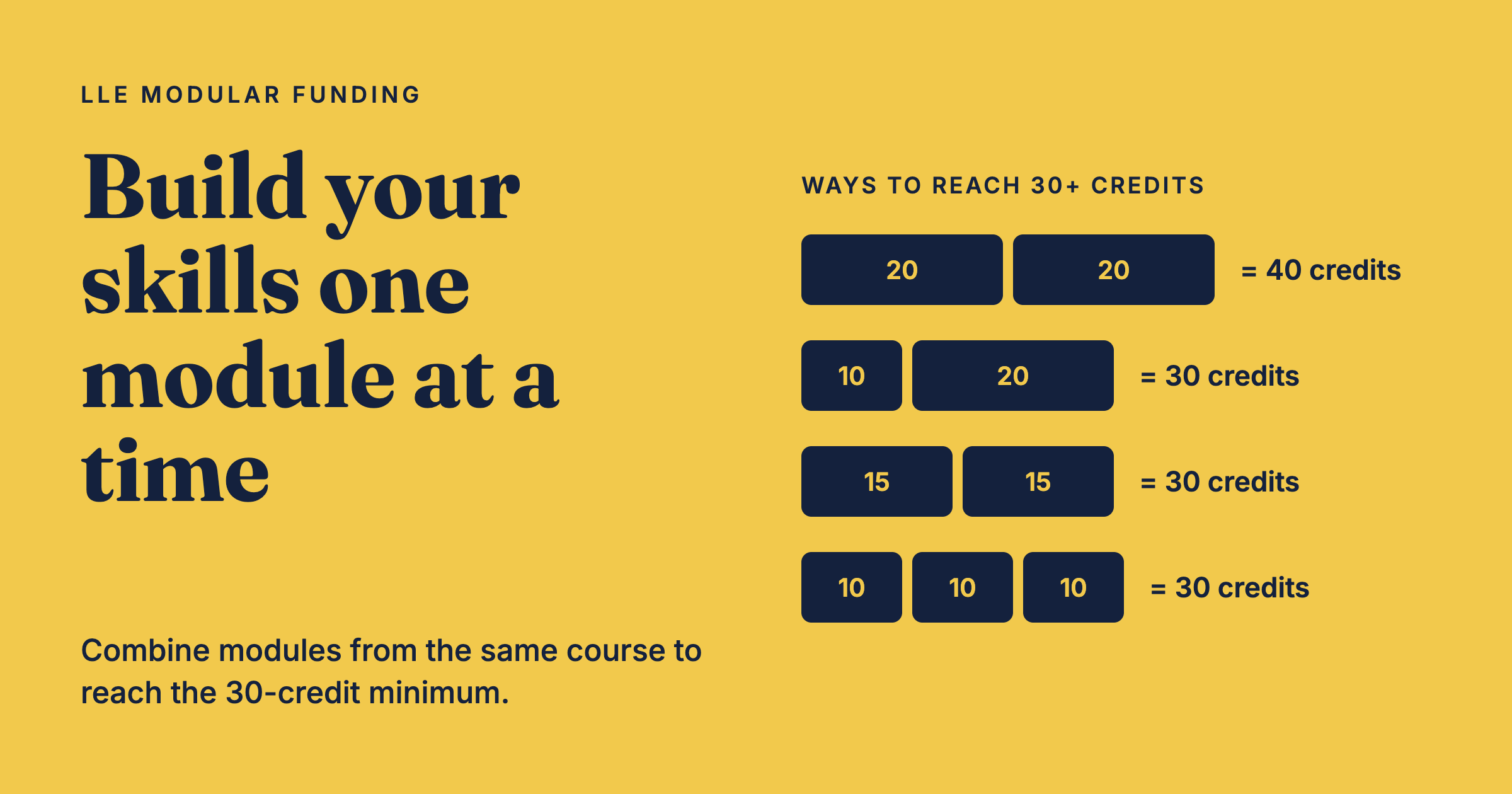
- Be worth at least 30 credits, or be a bundle of modules from the same parent course that add up to 30 or more
- Have a single qualification level (4, 5 or 6)
- Be assessed, with a standardised transcript issued on completion
- Not be delivered through a franchised arrangement
Bundles are flexible. Two 20-credit modules, two 15-credit modules, or three 10-credit modules can all meet the 30-credit requirement. Providers don’t have to redesign their courses if they don’t already work in 30-credit blocks.
Who can get it?
Modular funding is only available to students living in England who study at a provider registered with the Office for Students. It follows the same nationality and residency rules as existing higher education student finance.
How your entitlement stretches
A new learner has an entitlement of £39,160, equal to four years of full-time tuition at 2026 to 2027 rates. That could cover more than 480 credits of learning, depending on cost per credit, and you can draw down loans for up to 180 credits a year.
In the government’s example, a learner spends £7,000 on a 120-credit course and keeps £32,160 for later study. Modules let you spread that entitlement across your working life.
Support while you study
- Maintenance loans are available on all designated in-person courses and modules. Distance learning is still outside maintenance support.
- Disabled Students’ Allowance is available for those studying 30 or more credits.
- To get tuition and maintenance loans, you must study at least 30 credits in a course year.
A phased rollout
The government is introducing modular funding carefully, to protect quality and public money. Expect a narrower range of modules at launch, expanding over time. Check that the specific module you want is eligible before you apply.
Easier moving between providers
The LLE is also meant to make credit transfer and recognition of prior learning more consistent. The standardised transcript you receive for each module is part of that, so your learning can count towards a full qualification later.
The takeaway
If you work in a priority field and want to build skills without committing to a full degree, modular funding could be a good fit. Confirm that your subject, provider and module meet the rules, then use your student finance account to check your balance.