
The Lifelong Learning Entitlement (LLE): What It Is and How It Will Work in England
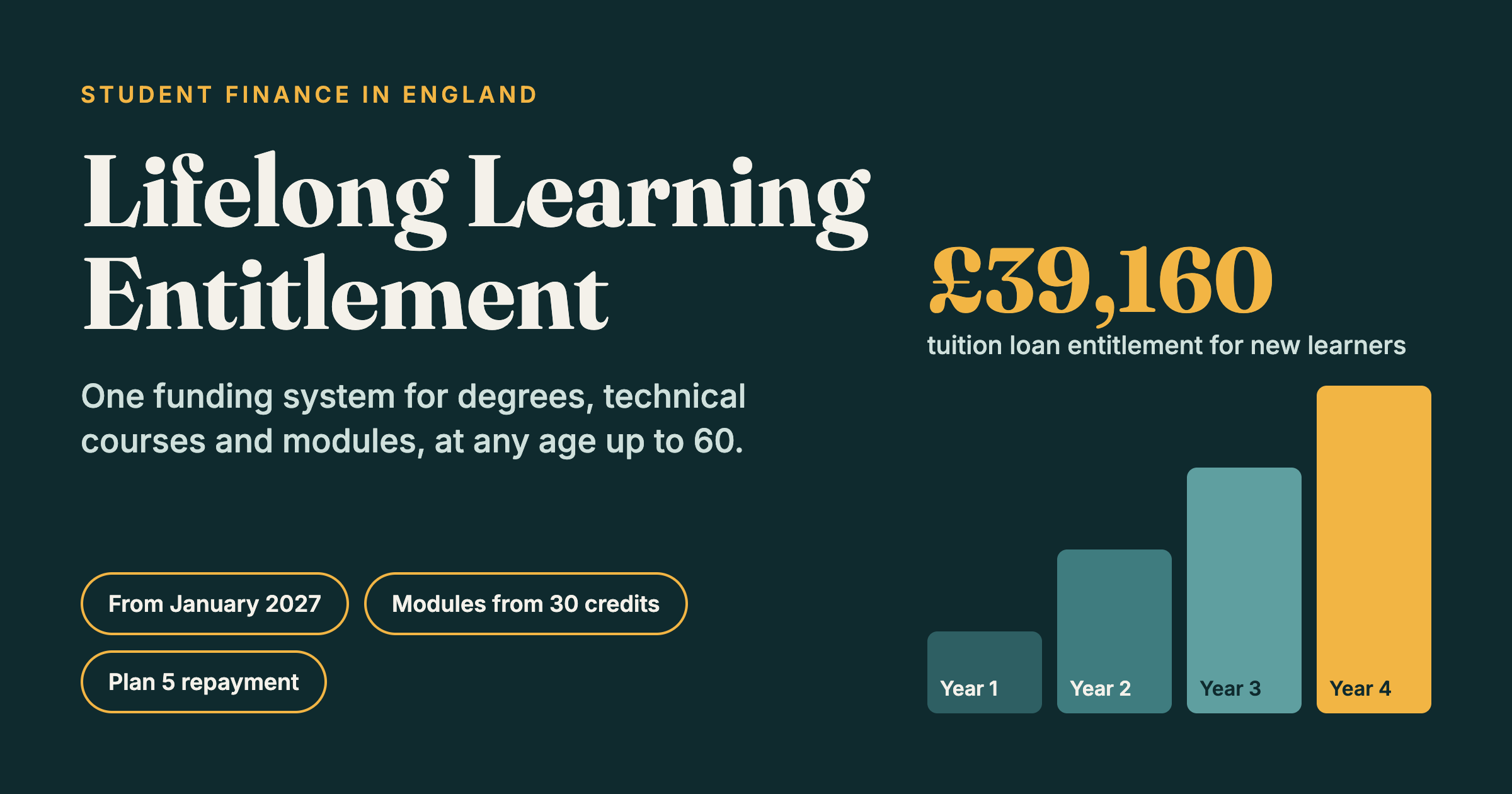
England’s post-18 student finance system is about to change. From January 2027, the Lifelong Learning Entitlement (LLE) will replace the current system with a single funding framework for higher education and technical study. Here’s what it means for you.
What is the LLE?
The LLE replaces two existing forms of funding:
- Higher education (HE) student finance loans
- Advanced learner loans for level 4, 5 and 6 qualifications
Learners can apply for LLE funding from late October 2026 for courses and modules starting from January 2027 onwards. The aim is to let people gain new skills and qualifications at a time that suits them, whether they are 18 or well into their careers.
How much can you borrow?
A new learner can access a tuition fee loan of up to £39,160. That equals four years of study at the 2026 to 2027 maximum fee of £9,790 per year. You can also get a maintenance loan for living costs on in-person courses. Extra help is available for disabled students, childcare costs and travel.
You can use your entitlement flexibly. £39,160 could fund more than 480 credits of learning, depending on the per-credit cost, and you can draw down loans for up to 180 credits per year. For example, if you use £7,000 on a 120-credit course, you keep £32,160 for later study.
Returning learners will have a reduced entitlement based on previous funding. A typical graduate of a three-year degree (worth £29,370 at 2026 to 2027 fees) would have a £9,790 residual entitlement.
Who is eligible?
- The LLE is open to new learners and to returning learners who have studied before.
- Nationality and residency rules follow the existing HE student finance rules.
- Tuition loans are available up to age 60 at the start of the course. Learners aged 60 or over may still qualify for maintenance support, but not a tuition fee loan.
- If you already have funding for a course you started before 1 January 2027, you stay on the current system for that course.
What courses and modules are covered?
The LLE covers full courses at levels 4 to 6, such as degrees, technical qualifications and designated distance-learning courses. It also covers postgraduate courses currently funded by HE student finance, including postgraduate initial teacher training, PGCEs, integrated master’s degrees and foundation years that form part of a bachelor’s degree.
Modular funding
One of the biggest changes is funding for individual modules. These include modules of approved Higher Technical Qualifications (HTQs) at levels 4 to 5, and modules from full level 6 qualifications in priority subjects: computing, engineering, architecture (excluding landscape gardening), physics and astronomy, mathematical sciences, nursing and midwifery, allied health professions, chemistry, economics, and health and social care.
To qualify, a module must:
- Be part of an existing designated full course delivered by the same provider
- Be worth at least 30 credits, or be a bundle of modules from the same course totalling 30 or more
- Sit at a single level (4, 5 or 6)
- Be assessed and come with a standardised transcript
- Not be delivered through a franchised arrangement
Modular funding is only available to students living in England at an Office for Students-registered provider. The government is taking a phased approach, so the range of modules will be narrower at launch and expand over time.
Extra entitlement: when your balance hits £0
Priority additional entitlement
Learners whose balance reaches £0 can get tuition fee loans to finish certain priority courses, and existing graduates can use it to retrain. Eligible subjects include medicine, dentistry, nursing, midwifery, many allied health professions (such as physiotherapy, radiography, occupational therapy and dietetics), initial teacher training and social work. It supports full courses only, not individual modules.
Special additional entitlement
For longer courses outside the priority list, learners can get up to two extra years (240 credits). This applies to veterinary surgery, architecture (including Part 2 courses), and bachelor’s and integrated master’s degrees in Scotland. It can fund the final year, or a year of intercalation or repeat study. It can also cover foundation years, study abroad, work placements and the Turing scheme.
Repeat study
Repeat study comes with the usual maintenance support and repayment terms. If illness, bereavement or other compelling personal reasons affect your studies, the cost of the affected study is added back to your balance. Learners on 4- or 6-year courses can also get additional entitlement for repeat study that isn’t for compelling personal reasons.
Tuition fees and credits
Fee limits will be based on credits rather than academic years. To qualify for tuition and maintenance loans, you must study at least 30 credits in a course year. If you have less than £1,587.50 of entitlement left (at 2026 to 2027 rates), you may need to self-fund part of the tuition fees, and you’ll only get a maintenance loan if you use your remaining balance on that course.
Maintenance loans, grants and DSA
- Maintenance loans will be available on all designated in-person courses and modules, paid in up to three instalments at launch. Distance learning remains out of scope.
- Targeted support grants (for dependants and travel) will be available to full-time learners, meaning at least 120 credits per year. These don’t need to be repaid.
- Disabled Students’ Allowance (DSA) will be available for those studying 30 or more credits per course or module. It also covers courses previously funded by advanced learner loans.
How repayments work
LLE loans follow the Plan 5 repayment system:
- Repayments start once you’ve left your course and earn more than £25,000 a year (£2,083 a month or £480 a week)
- You repay 9% of your gross salary above the threshold, usually deducted automatically alongside tax and National Insurance
- Repayments stop if you’ve repaid the loan, your salary drops below the threshold, or 40 years have passed and the loan is cancelled
- If you also have an existing undergraduate loan, you’ll make a single 9% repayment above the threshold
Your student finance account
You’ll be able to log in to check your LLE balance, track applications, and get information and guidance to plan your learning and career.
Credit transfer and recognition of prior learning
The government plans to make it easier to move between providers through consistent credit transfer and recognition of prior learning. Providers delivering LLE-funded modules must issue a standardised transcript on completion. The government also plans to consult on break points in degree programmes for greater flexibility.
The bottom line
The LLE is designed to make learning something you can return to throughout your working life. If you’re thinking about a degree, a technical qualification or a priority-subject module, check your eligibility and balance through your student finance account once applications open in late October 2026.